Showing posts with label Induction Furnace Manufacturers in India. Show all posts

Tuesday, 9 February 2016

Induction Billet Heater Manufacturers

Manufactured to perfection, Stead fast is one of the excellent and leading Induction Billet Heater Manufacturers in India. Due to its high efficiency, consistent performance and longer functional life, the billet heating machine is highly reckoned in the global market. We have manufactured the billet machine for efficient heating of circular or square section billets. Our offered range of billet machine is widely used for forging application. This Induction Billet Heating Machine is stringently checked on several parameters like sturdiness, construction and efficiency.

We are offering Induction Billet Heater to our customers which are made by using a high quality of raw materials. These range of products can be customized as per our valued client specification across the globe.


Induction heating is a non-contact process which uses the principle of electromagnetic induction to produce heat in a workpiece. By placing a conductive material in to a strong alternating magnetic field, electrical current is made to flow in the material, thereby causing joule heating. In magnetic materials, further heat is generated below the curie point due to hysteresis losses. The generated current flows predominantly in the surface layer, the depth of this layer being dictated by the frequency of the alternating field and the permeability of the material.

BENEFITS OF Induction Billet Heater

Process controllability
Unlike a traditional gas furnace the induction system requires no pre-heat cycle or controlled shutdown. The heat is available on demand. In addition to the benefits of rapid availability in the event of a down stream interruption to production the power can be switched off thus saving energy and reducing scaling on the components.

Energy efficiency
Due to the heat being generated within the component energy transfer is extremely efficient. The Induction Billet Heater heats only the part not the atmosphere around it.

Rapid temperature rise
High power densities ensure that the component reaches temperature extremely rapidly. This results in reduction of scale, surface defects and undesirable effects on the surface metallurgy.

Process consistency
The induction heating process produces extremely uniform consistent heat. This improves accuracy of the forging and can reduce post forging machining allowances and have a positive effect on die life. In conventional heaters i.e gas or coal fired burning losses are much higher may be 5 to 10% depending size of the work piece, but in Induction Billet Heater maximum burning loss is 1%.

About us :

Being one of a leading Induction Billet heater manufacturers we assure high quality at lowest price. Other than billet heaters, we are well know Induction furnace manufacturers. Our motto is to provide quality products and top class services.

Thursday, 4 February 2016

How to select Inductors for Billet heating ?

Induction heating is generally used to warm metals forging so as to precede hot shaping, annoying, moving, expulsion, and different techniques. Billets are warmed either in cut lengths or constantly and are produced in presses, mallets, or upsetters, or are expelled. Steel parts by a long shot speak to the lion's share of hot-shaped billets, albeit different materials counting titanium, aluminum, copper, metal, bronze, furthermore, nickel are additionally induction warmed for hot framing.

The introductory temperature of the billet before induction heating might be uniform (at encompassing temperature) on the other hand nonuniform. It is normally required to raise the billet's temperature to a predetermined level and degree of warmth consistency. The consistency prerequisite might incorporate greatest bearable temperature differentials — "surface-to-center," "end-to-end," and "side to-side."

A longitudinal warm inclination along the billet's length (profile heating) is here and there wanted when heating certain billets preceding their immediate or consistent Contingent on the application, powers from hundreds to a huge number of kilowatts and frequencies regularly in the line recurrence (50 to 60 Hz) to 3 kHz reach are the most normally utilized for induction heating of huge billets. The most well known billet-heating methodologies are dynamic multistage level heating and static heating. This section focuses on the advantages and disadvantages of each.

Two Approaches Compared

In dynamic multistage even heating, two then again more billets are moved (by means of pusher, indexing instrument, on the other hand strolling shaft, for instance) through a single loop or multicoil flat induction heater . Therefore, the billet is consecutively (logically) warmed at foreordained positions within the induction heater.


In static heating, a billet is put into an induction loop having a vertical or flat game plan for a given timeframe while a set measure of force is connected until it achieves the wanted heating conditions (temperature and level of consistency). The warmed billet is then removed from the inductor and conveyed to the framing station. Another cool billet is then stacked into the loop and the procedure rehashes. Either approach can utilize a defensive climate in the event that required.

Dynamic multistage level heating is prominent for little and medium-size billets (normally less than 6 in. [150 mm] in distance across). Whenever heating extensive breadth steel or titanium billets (8 to 12 in. [200 to 300 mm] and bigger), it is frequently invaluable to utilize static heating with a vertical loop game plan on the other hand a blend of the dynamic multistage level technique for preheating and the static vertical strategy for conclusive heating.

A steel billet being released in the wake of being statically warmed in a vertical inductor. Billet exchange, tipping, and charging instruments are situated beneath the stage and work as follows :

• Billets to be induction warmed are conveyed to the vertical cells by a trolley transport or roller track.

• The billet is then exchanged sideways by tipping the trolley stage or by an inclined occupying arm embedded into the roller track. The billet moves off into a moderate station and afterward onto a flat support.


• This support shapes part of a shaking holder which turns 90° and sets the billet vertically over a charging jack, which raises the billet vertically into the inductor. At the point when the heating cycle is finished, the control framework checks whether the press is prepared to acknowledge the billet. On the off chance that it isn't, the inductor changes its mode from heating to holding.

Displaying Can Save Time, Money

Experience picked up on past occupations and the capacity to PC model induction forms give a safe place when outlining new induction billet heating frameworks. This mix of cutting edge programming and a complex designing foundation empowers producers of induction heating gear to rapidly decide points of interest of the procedure that could be expensive, tedious, and, in a few cases, greatly troublesome, if not outlandish, to decide tentatively.


Evaluating software :

There are a few programming program accessible for demonstrating dynamic multistage level induction heaters. It is more hard to discover programming proper for PC demonstrating of static vertical billet heaters. To choose whether a system is suitable for demonstrating vertical heaters, its abilities must be altogether caught on. What takes after is an agenda of what clients should consider while assessing potential programming for demonstrating vertical billet heating frameworks:

• Electromagnetic end impact.

• Thermal edge impacts (Lambert's law and perspective components, for instance).

• Tight coupling of both electromagnetic and warm procedures. ("Regulated" coupling ought to be utilized. "Two-stage" coupling ought to be dodged since it doesn't give the precision required for generally applications.)

• Presence of warm protection, and the capacity to model warmth trade in the middle of unmanageable and warmed billet.

• Nonlinear interrelated nature of the material's physical properties.

• Specifics of loop windings and copper tubing.

• Surface misfortunes because of thermal radiation and convection.

• Presence of attractive flux concentrators, diverters, also, or flux extenders.

• Heat exchange between warmed billet and platform.

• Transient procedures ("chilly" and "warm" startup, also, a capacity to hold the warmed billet inside the induction loop if the framing machine is not prepared to acknowledge it).

• Possibility of the billet having a nonuniform beginning temperature conveyance before induction heating (for instance, the presence of outspread and longitudinal temperature slopes in the wake of penetrating or constant throwing).

• Cooling of the billet in air amid its exchange from inductor to shaping machine.


Who we are :


 We are leading Induction Furnace Manufacturers in India . provides world class induction heating and melting solutions for both ferrous and Non ferrous with a great focus on customization so that every machine is nothing less than perfect. Other than this we are also a leading Induction Billet heater Manufacturers. With a family of more than 400 satisfied customers all over the country and abroad, Stead Fast Engineers is expanding at a rapid pace. With offices located in major cities we ensure that the service is quick and effective and breakdown time is negligible.  

Tuesday, 12 January 2016

Induction Furnace manufacturers, exporters and suppliers


We are Stead fast Engineers , a leading Induction furnace manufacturing company in India, founded in 1990. we offers custom Heating and melting solution for ferrous and non ferrous Industries.

Our specialty :

- Provides Reliable, Economic and efficient Induction Furnace .
- our products have Highest efficiency, Low power consumption.
- optimum production
- design using futuristic trends
- design up-gradation to suit.
- trouble free operation.
- Our company specialize in quality Induction furnaces.
- power range is from 40 kw to 20000 kw .

We supply, Export and manufacturing wholesale Induction furnaces. Induction furnace available with PLC and digital controlled , control panel. Production capacity is 25-30 furnace per month.


Our products :

Stead Fast Engineers is pioneer in manufacturing Induction furnace under the brand name stefen capacity ranging from 20 kg to 20,000 kg.

Our Induction furnace are :
corrosion Resistance
high performance
Ease in operation
Durability

Types of Induction furnace :

Induction melting furnace
Induction heating system
Induction spares
Induction Furnace lining machine

product features :

Highest efficiency of power supply
lower cost
constant full power from start to end
accurate, diagnostic with easy to read fault indication and limits.
Heavy duty, Higher efficiency
Advanced rugged Semiconductors are chosen for better re liabilities.
Fast protection System.
Guaranteed melt rate

Our Success Story :

we are fastest growing Induction furnace manufacturing company. In our years of experienced , we Installed more than 1000 furnaces . We are No. 1 in some location.


We supply Furnaces to the Automobile industries centrifugal casting Non ferrous casting industries, steel plant. http://www.steadfastengg.com/

Monday, 14 December 2015

Designing of Inductor

It is inside of the inductor that the differing attractive field required for prompting warming is produced, through the stream of substituting current.

Inductor configuration is subsequently a standout amongst the most imperative parts of the general instigation warming machine. A very much outlined inductor gives the best possible warming example to your part and amplifies the effectiveness of the actuation warming power supply, while as yet permitting simple insertion and evacuation of the part.


The inductor does not need to be formed in a helix. With the right plan, it is conceivable to warm conductive materials of any size and shape, furthermore conceivable to warm just the part of material required. It is even conceivable to warm diverse zones of the part at the same or distinctive temperatures by method for a legitimate configuration of the inductor geometry. Temperature consistency inside of your part is accomplished through right inductor plan. The best consistency can be accomplished in round parts. Because of the way of electrical current way stream, parts with sharp edges could specially warm in those zones if the best possible inductor outline is not utilized.

Coupling Efficiency

There is a corresponding relationship between the measure of current stream and separation between the inductor and part. Setting the part near the inductor builds the stream of current and the measure of heat prompted in the part. This relationship is alluded to as the coupling proficiency of the inductor.

Fundamental Construction

Inductors are regularly made of copper tubing - a great conduit of heat and electricity - with a distance across of 1/8" to 3/16"; bigger copper loop congregations are made for applications, for example, strip metal heating and pipe heating. Inductors are normally cooled by coursing water, and are frequently uniquely crafted to fit the shape and size of the part to be heated. So inductors can have single or different turns; have a helical, round or square shape; or outlined as inner (part inside inductor) or outer (part nearby inductor).

Advance Design and Manufacturing :


Stead Fast Engineers provides world class induction heating System and melting solutions for both ferrous and Non ferrous with a great focus on customization so that every machine is nothing less than perfect. With a family of more than 400 satisfied customers all over the country and abroad, Stead Fast Engineers is expanding at a rapid pace. With offices located in major cities we ensure that the service is quick and effective and breakdown time is negligible. Adopting stringent quality management systems during different stages of production - the pre-process, In-process and pre-dispatch stage we believe in manufacturing the best quality every time.

Monday, 7 December 2015

Important Factors to Consider in Induction Furnace


The efficiency of an induction heating system for a specific application depends on several factors: the characteristics of the part itself, the design of the inductor, the capacity of the power supply, and the amount of temperature change required for the application.


The Characteristics of the Part
METAL OR PLASTIC
To begin with, induction heating works straightforwardly just with conductive materials, ordinarily metals. Plastics and other non-conductive materials can frequently be heated by implication by first heating a conductive metal susceptor which exchanges heat to the non-conductive material.
Attractive OR NON-MAGNETIC
It is less demanding to heat attractive materials. Notwithstanding the heat incited by swirl streams, attractive materials likewise deliver heat through what is known as the hysteresis impact (depicted previously). This impact stops to happen at temperatures over the "Curie" point - the temperature at which an attractive material loses its attractive properties. The relative resistance of attractive materials is appraised on a "penetrability" size of 100 to 500; while non-magnetics have a porousness of 1, attractive materials can have a penetrability as high as 500.
THICK OR THIN
With conductive materials, around 85% of the heating impact happens at first glance or "skin" of the part; the heating power reduces as the separation from the surface increases.So little or meager parts by and large heat more rapidly than vast thick parts, particularly if the bigger parts should be heated completely through.
Examination has demonstrated a relationship between the frequency of the rotating current and the heating profundity of entrance: the higher the frequency, the shallower the heating in the part. Frequencies of 100 to 400 kHz deliver moderately high-vitality heat, perfect for rapidly heating little parts or the surface/skin of bigger parts. For profound, entering heat, longer heating cycles at lower frequencies of 5 to 30 kHz have been appeared to be best.


 RESISTIVITY
In the event that you utilize precisely the same procedure to heat two same size bits of steel and copper, the outcomes will be entirely distinctive. Why? Steel – alongside carbon, tin and tungsten – has high electrical resistivity. Since these metals emphatically oppose the present stream, heat develops rapidly. Low resistivity metals, for example, copper, metal and aluminum take more time to heat. Resistivity increments with temperature, so an extremely hot bit of steel will be more responsive to induction heating than a frosty piece.

Inductor Design
It is inside of the inductor that the fluctuating attractive field required for induction heating is produced through the stream of exchanging current. So inductor outline is a standout amongst the most vital parts of the general framework. A very much planned inductor gives the best possible heating example to your part and augments the productivity of the induction heating power supply, while as yet permitting simple insertion and evacuation of the part.

Power Supply Capacity
The measure of the induction power supply required for heating a specific part can be effectively ascertained. Initial, one must decide the amount of vitality should be exchanged to the work-piece. This relies on upon the mass of the material being heated, the particular heat of the material, and the ascent in temperature required. Heat misfortunes from conduction, convection and radiation ought to likewise be considered.

Level of Temperature Change Required
At last, the productivity of induction heating for particular application relies on upon the measure of temperature change required. An extensive variety of temperature changes can be accomodated; as a dependable guideline, more induction heating power is for the most part used to build the level of temperature change.

Stead Fast Engineers is a leading and good quality Induction Furnace manufacturers in India. Possibly because we believe in innovation and skilled manpower  and penchant for quality and of course because of the trust that has been placed on us by our customers, we have built up an undoubtedly long list of prestigious clientele. Visit Our Site for more details : http://www.steadfastengg.com/

Thursday, 3 December 2015

Unique Technology for Induction Billet Heaters

Induction forging alludes to the utilization of an induction heater to pre-heat metals preceding distortion utilizing a press or sledge. Regularly metals are heated to somewhere around 1,100 and 1,200 °C (2,010 and 2,190 °F) to expand their flexibility and help stream in the forging bite the dust.

Induction heating is a non-contact process which utilizes the standard of electromagnetic induction to create heat in a work piece. By setting a conductive material into a solid rotating attractive field, electric current is made to stream in the material, along these lines creating Joule heating. In attractive materials, further heat is produced underneath the Curie indicate due hysteresis misfortunes. The created current is relevantly in the surface layer, the profundity of this layer being directed by the recurrence of the exchanging field and the porousness of the material.

Billet Heating :

In the induction billet heater the entire of the billet or slug is heated. Ordinarily for short billets or slugs a container or dish is utilized to consequently display the billets in line to squeeze rollers, chain driven
tractor units or at times pneumatic pushers. The billets are then determined through the loop one behind the other on water cooled rails or earthenware liners are utilized through the curl bore which decrease contact and anticipate wear. The length of the curl is an element of the required drench time, the process duration per segment and the length of the billet. In high volume extensive cross area work it is not bizarre to have 4 or 5 curls in arrangement to give 5 m (16 ft) of loop or more. 

Common place parts handled by in line billet heating:

 Little crankshafts
 Camshafts
 Pneumatic and pressure driven fittings
 Sledge heads
 Motor valves
 Single shot

shot billet heating:

For long billets, single shot heating can be utilized. This procedure uses comparable frameworks to bar end heating aside from that the entire of the billet is crashed into individual loops. Likewise with bar end heating the quantity of curls is administered by ΔT required and the warm properties of the material being heated. Run of the mill parts prepared by single shot billet heating:
 Lorry axles
 Marine camshaf


Induction Billet Heatering Systems :

Stead Fast Engineers supply a broad range of induction billet heating systems for virtually all forge heating applications. Advantages of our induction billet heaters include:
• High efficiency
• Proven Design
• Reduced customer start up time
• Forge shop proven
• Excellent customer reference list
• Advanced PLC control, power & temperature control
• Quick release connections for both power & water
• World wide customer service support
• Reliable
• Heavy Duty Construction, for toughest forging conditions
• IGBT (Insulated Gate Bi-Polar Transistor) Design

Manufactured to perfection, we are one of the excellent and leading exporters of Induction Billet Heating Machine. Due to its high efficiency, consistent performance and longer functional life, the billet heating machine is highly reckoned in the global market. We have manufactured the billet machine for efficient heating of circular or square section billets. Our offered range of billet machine is widely used for forging application. This Induction Billet Heating Machine is stringently checked on several parameters like sturdiness, construction and efficiency.
For more Information Visit Our website : http://www.steadfastengg.com/

Wednesday, 2 December 2015

How does Induction heating Work ?

 Introduction :

Induction heating is a precise, quick, repeatable, proficient, non-contact strategy for heating metals or some other electrically-conductive materials.

An induction heating framework comprises of an induction power supply to convert line energy to an exchanging current and conveying it to a workhead, and a work loop for creating an electromagnetic field inside of the curl. The work piece is situated in the curl such this field prompts a current in the work piece, which thusly delivers heat.

The water-cooled loop is situated around or circumscribing the work piece. It doesn't contact the work piece, and the warmth is just delivered by the actuated current transmitted through the work piece. The material used to make the work piece can be a metal, for example, copper, aluminum, steel, or metal. It can likewise be a semiconductor, for example, graphite, carbon or silicon carbide.
For heating non-conductive materials, for example, plastics or glass, induction can be utilized to warm an electrically-conductive susceptor e.g., graphite, which then passes the warmth to the non-directing material.

Induction heating discovers applications in procedures where temperatures are as low as 100ºC (212°F) and as high as 3000°C (5432°F). It is likewise utilized as a part of short heating procedures going on for not as much as a large portion of a second and in heating procedures that stretch out more than a while.

Induction heating is utilized both residential and business cooking, in a few applications, for example, warmth treating, fastening, preheating for welding, melting, therapist fitting in industry, fixing, brazing, curing, and in and in research and development.

How Does Induction Heating Work?

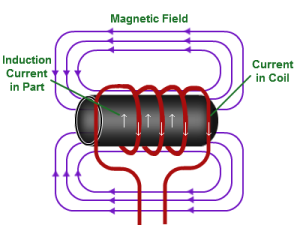
Induction produces an electromagnetic field in a coil to transfer energy to a work piece to be heated. When the electrical current passes along a wire, a magnetic field is produced around that wire.

Key Benefits of Induction :

 The benefits of induction are:
 Efficient and quick heating
 Accurate, repeatable heating
 Safe heating as there is no flame
 Prolonged life of fixturing due to accurate heating
 Methods of Induction Heating

Induction heating is done using two methods:

The first method is referred to as eddy current heating from the I²R losses caused from the resistivity of a work piece’s material. The second is referred to as hysteretic heating, in which energy is produced within a part by the alternating magnetic field generated by the coil modifying the component’s magnetic polarity.

Hysteretic heating occurs in a component up to the Curie temperature when the material’s magnetic permeability decreases to 1 and hysteretic heating is reduced. Eddy current heating constitutes the remaining induction heating effect.
When there is a change in the direction of electrical current (AC) the magnetic field generated fails, and is produced in the reverse direction, as the direction of the current is reversed. When a second wire is positioned in that alternating magnetic field, an alternating current is produced in the second wire.
The current transmitted through the second wire and that through the first wire are proportional to each other and also to the inverse of the square of the distance between them.
When the wire in this model is substituted with a coil, the alternating current on the coil generates an electromagnetic field and while the work piece to be heated is in the field, the work piece matches to the second wire and an alternating current is produced in the work piece. The I²R losses of the material resistivity of the work piece causes heat to be created in the work piece of the work piece’s material resistivity. This is called eddy current heating.

Working of an Induction Coil

With the assistance of a rotating electric field, vitality is transmitted to the work piece with a work coil.
The rotating current passing through the coil delivers the electromagnetic field which instigates a present going in the work piece as a mirror picture to the present going in the work coil. The work coil/inductor is a piece of the induction heating framework that shows the viability and proficiency of the work piece when it is warmed. Work coils are of various sorts running from complex to basic.
The helical injury (or solenoid) coil is an illustration of basic coil, which comprises of numerous turns of copper tube twisted around a mandrel. A coil accuracy machined from strong copper and brazed together is a sample of complex coil.

About us : 

A good induction furnace manufacturer is not just a company that makes the furnace. A good manufacturer will provide other services to assist the equipment’s purchaser into the future. If you are looking for Induction Furnace Manufacturers providers and exporters, then your search ends here.stead Fast Engineers Pvt Ltd is a one of the leading manufacturers in India where you can Get Best Induction furnace. we provide various type of heating and melting equipments . visit for more detail : http://www.steadfastengg.com/

Wednesday, 25 November 2015

Types of Induction Furnace


The principle of induction melting is that a high voltage electrical supply from a primary induces a low voltage, high current within the metal, or secondary. heating is just a technique of transferring heat.

Induction furnaces square measure ideal for softening and alloying a large style of metals with minimum melt losses, however, very little purification of the metal is feasible.

There are two main types of induction furnace : 
1. Coreless 
2. Channel

Coreless Induction Furnaces : 

The heart of the coreless induction furnace is that the coil, that consists of a hollow section of significant duty, high physical phenomenon copper tube that is wound into a turbinate coil. Coil form is contained inside a steel shell and magnetic shielding is employed to forestall heating of the supporting shell. to safeguard it from warming, the coil is cool, the water bing recirculated and cooled during a cooling. The shell is supported on trunnions on that the furnace tils to facilitate running.

The vessel is created by ramming a granular refractory between the coil and a hollow internal former that is liquified away with the primary heat feat a mold lining.

The power cubmicle converts the voltage and frequency of main offer, ot that needed for electrical melting. Frequencies utilized in induction melting vary from fifty cycles per second (mains frequency) to ten,000 cycles per second (high frequency). the upper the operational frequency, the bigger the most quantity of power which will be applied to a chamber of given capability and also the lower the quantity of turbulence elicited.

When the charge material is liquified, the interaction of the magnetic flux and also the electrical currents flowing within the coil manufacture a stirring action inside the liquified metal. This stirring action forces the liquified metal to rise upwards within the centre inflicting the characteristic gristle on the surface of the metal. The degree of stirring action is influenced by the ability and frequency applied further because the size and form of the coil and also the density and viscousness of the liquified metal. The stirring action inside the tub is vital because it helps with combination of alloys and melting of turnings further as homogenising of temperature throughout the chamber. Excessive stirring will increase gas obtain, lining wear and oxidisation of alloys.

The coreless induction chamber has for the most part replaced the vessel chamber, particularly for melting of high temperature alloys. The coreless induction chamber is often wont to soften all grades of steels and irons further as several non-ferrous alloys. The chamber smart} for remelting and alloying attributable to the high degree of management over temperature and chemistry whereas the induction current provides good circulation of the soften.


Channel Induction Furnaces :

The channel induction chamber consists of a refractory lined steel shell that contains the liquified metal. connected to the steel shell and connected by a throat is an induction unit that forms the melting part of the chamber. The induction unit consists of AN iron core within the variety of a hoop around that a primary coil is wound. This assembly forms an easy electrical device within which the liquified metal loops includes the secondary part. the warmth generated inside the loop causes the metal to flow into into the most well of the chamber. The circulation of the liquified metal effects a helpful stirring action within the soften.

Channel induction furnaces square measure usually used for melting low temperature alloys and or as a holding and superheating unit for higher temperature alloys like forged iron. Channel induction furnaces are often used as holders for metal molten off peak in coreless induction induction units thereby reducing total melting prices by avoiding peak demand charges.


Stead Fast Engineers provide world class induction heating and melting solutions .Stead Fast Engineers manufactures world class induction melting furnaces under the brand name 'STEFEN'. 
STEFEN Quick melt and Smart melt furnaces are designed to increase the customer’s profitability and improve his market credibility by minimizing down time.

Sunday, 15 November 2015

MAGNETIC HEATING OF BILLETS

INTRODUCTION
induction-heating
In July 2008 the new innovation – magnetic billet heater – was put into business operation in Germany (German aluminum expulsion works Weserlau GmbH and Co. KG). The second framework has been requested by Italian backup of Sapa in Bolzano. The beginnings of this innovation can be found in 2004. Organizations Zenergy Power and Bültmann got financing from Germany's ecological financing organization DBU to add to another innovation for billet heating. The main model was appeared in April 2005 at the Hannover Fair. Further with the support from the DBU, the gadget was produced and put into administration at Wese
HISTORY AND ADVANTAGES OF MAGNETIC HEATING :
In July 2008 the new innovation – magnetic billet heater – was put into business operation in Germany (German aluminum expulsion works Weserlau GmbH and Co. KG). The second framework has been requested by Italian backup of Sapa in Bolzano. The beginnings of this innovation can be found in 2004. Organizations Zenergy Power and Bültmann got financing from Germany's ecological financing organization DBU to add to another innovation for billet heating. The main model was appeared in April 2005 at the Hannover Fair. Further with the support from the DBU, the gadget was produced and put into administration at Wese.
CONVENTIONAL INDUCTION HEATING (AC HEATING) :
Electrically conductive materials are today heated or dissolved in routine incitement heating gadgets. Billet is put inside copper curl. The curl is supplied by AC current and creates electromagnetic field that alters course in time. The field affects vortex currents in the workpiece (Faraday's law) what's more, vortex currents heat up the billet because of its electrical resistivity (Joule's law). In both parts of the gadget (inductor loop, workpiece) electrical misfortunes happens. The heating of the curl is the principle wellspring of vitality misfortunes in traditional AC incitement heating frameworks. Thus, loop must be cooled with water to keep from softening. The degree of the misfortunes relies on upon the proportion of the resistances of the loop and the billet. The proficiency of the framework is 50 – 60%. Traditional gadgets have a few impediments. Air conditioning heaters working with basic force network frequencies create whirlpool currents for the most part near to the surface of the workpiece – it delays the time of heating. AC induction heating further requires a medium voltage power supply and VAR compensation.
DC MAGNETIC HEATING :
Magnetic heater in Weserlau comprises of DC fueled superconductive magnetic curl cooled to low temperature. The loop produces an adequately solid magnetic field with a force information of 10W.
Magnetic field of a DC fueled curl is not fluctuating in time, the billet is pivoted inside of the field in request to affect vortex currents. Vortex currents work to contradict the revolution and make an in number braking  torque. This is overcome by mechanical electric engines of a size of 100 – 50 kW. Engines are supplied by standard recurrence converters (misfortunes 2-3% of the aggregate influence utilization of the heater). Cooling framework and power supply devour around 13 kW, the aggregate productivity (counting all misfortunes brought on by fringe specialized gadgets) is more prominent than 80%. The heating procedure is speedier, more homogeneous Furthermore, exactly controllable. The framework doesn't require expansive cooling establishments, complex vitality supply and VAR pay. The heater comprises of four fundamental parts – superconducting magnet, refridgerator, engine and heating chamber. The fundamental part is the superconducting magnet that is kept at its working temperature by the refridgeration framework. The billets pivot in two thermally protected heating chambers, the rotational vitality is given by electric engines on either side. The engines can slide in also, out to oblige diverse billet lengths. No segment in the heater is subjected to noteworthy temperature expand, vibrations or some other mechanical anxiety compone
MAGNETIC HEATING ADVANTAGES:
  • Low frequencies
  • Wide material range
  • Temperature tapers
  • Low maintenance requirements
  • Reliabilit
Stead Fast Engineers provides world class induction heating and melting solutions for both ferrous and Non ferrous with a great focus on customization so that every machine is nothing less than perfect. With a family of more than 400 satisfied customers all over the country and abroad, Stead Fast Engineers is expanding at a rapid pace. With offices located in major cities we ensure that the service is quick and effective and breakdown time is negligible. Adopting stringent quality management systems during different stages of production - the pre-process, In-process and pre-dispatch stage we believe in manufacturing the best quality every time. http://www.steadfastengg.com/